A Confirmation & a Meditation on Event
Finding Signal in all the noise of an "obsolete" event

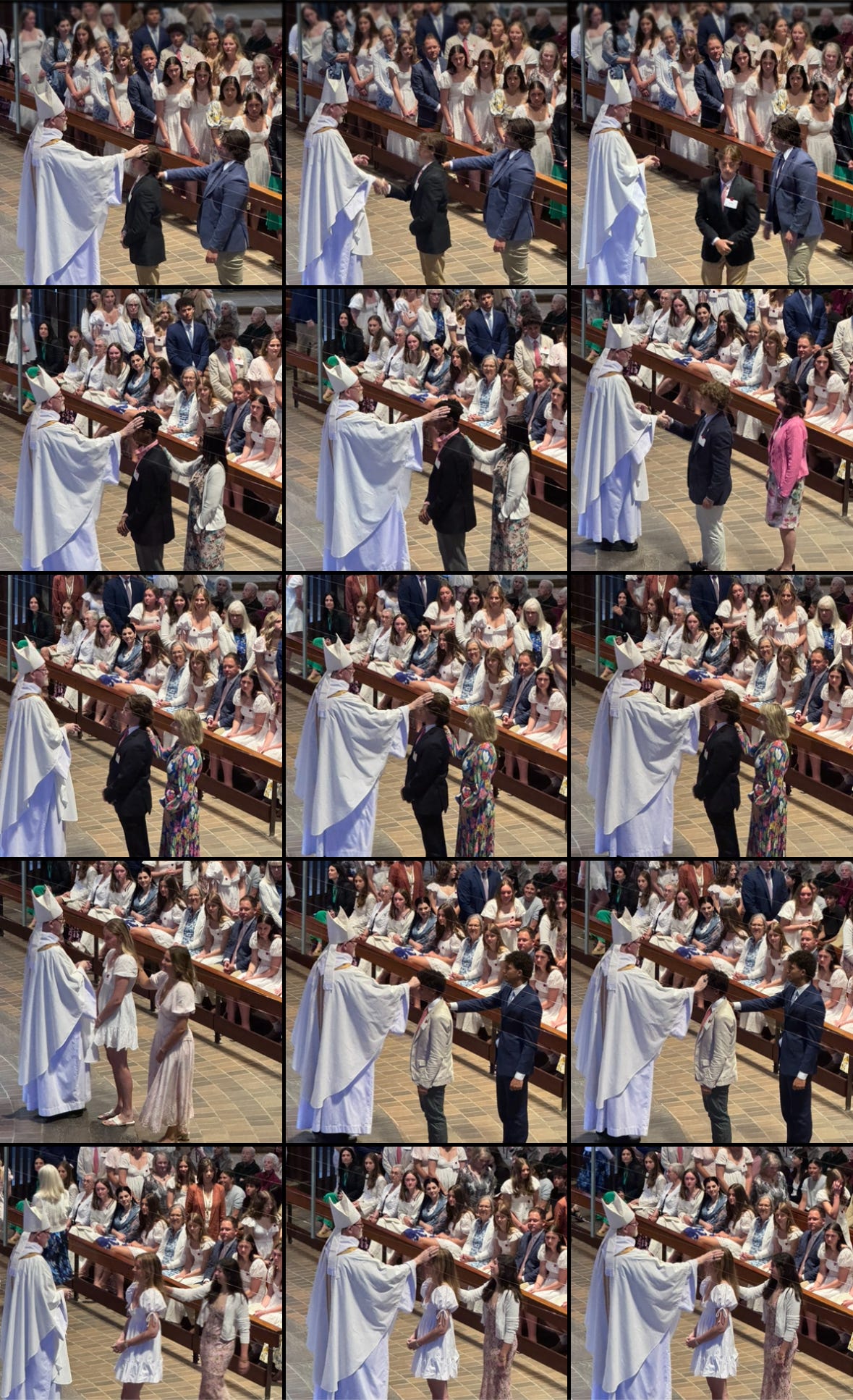
My son Jack got confirmed yesterday here at the Abbey church. He took the name Maximillian Kolbe and his sponsor is my own godson and nephew Sam. Much ink has been spilled and hot air expended on the topic of confirmation in the Catholic church. It has become a kind of sacramental hot potato, misunderstood, argued about, passed around. I did it as a high school junior in the spring of 1989. My own mother did it as part of her 8th grade in the spring of 1958. And each year folks batter around the best time to do it, etc. But I don’t really want to talk about the minutiae of the sacrament, but rather the phenomenon of such sacraments as Events. What is an “Event” and what do they “mark”?
Events or markers are add-ons of a sort, surrounding the simple sacramental gesture: chrism oil on the forehead, a slap on the cheek, and the words "Be sealed with the Gift of the Holy Spirit.” This sacrament need not the surrounding accoutrement, yet here we were. The ceremony is a whole affair unto itself, especially here at the Abbey. The Abbey church was loaded, well beyond the usual suspects as our yearly confirmation occurs on Mother’s Day. In addition to our students, families, cousins, uncles, grandmas…the whole panoply are present to mark the occasion. A regular Sunday mass, though of course a feast day, becomes (after the first weekend or two) pretty routine. Even the international students who have never stepped foot into a church figure it out. But this is not a regular Sunday. And you feel the change in charge. Suddenly all these other people are here, and many are dressed up in that peculiar way in which you can tell they never really dress like this in “real life”—too tight collars on shirts that still have the factory folds and heels that are creating blisters at every shift in weight.
So before doing even a paragraph of theology you can just tell that we have broken the routine and something special is happening.
Why do we do such things? What is even going on here? What is an “event” in the first place and why do we “mark” them?

I’ve been reading about the obsolescence of traditional religion in Christian Smith’s new book Why Religion Went Obsolete: The Demise of Traditional Faith in America. It felt a bit odd to be thinking through such ideas in the midst of an obviously retrograde “event” like a teenage Confirmation mass in an Abbey church. “What are we even doing here” I thought to myself. Mind you, I wasn’t asking it with tone or derision or panic. I was genuinely trying to see an old thing in a different way. I’ve been going to this confirmation mass for 18 years, and this time I was thrilled to watch my own son go through the ceremony and receive the sacrament, just as I was three years ago with my eldest daughter Hannah. But the “eventness” of this event struck me. I have a hard time shutting off my brain, and after years of trying to fight it, I just lean in. I carry around my cardstock tri-fold “nerd notes” with me at all times and when something strikes me, I jot it down. Here is what I wrote:
“…this whole thing ONLY make sense in an incarnate context – it’s not an idea – it’s a thing participated in. It’s a transcending HAPPENING – a presencing + invocation of spirit into flesh”
If you think my posts on X are a bit cryptic (hello @steve) then you should get a load of my nerd notes. So let me attempt to translate. This is what I think I meant yesterday:
“This confirmation event only makes sense when you understand it as something happening within a nested and embodied context. If you are not a Catholic, this is just such an odd thing to hear about and even odder to witness. When considered as merely an idea, a confirmation broken up into its constituent parts, the form is no where to be found. And the idea that a small bit of ointment upon a forehead and the saying of the words does something real strikes you as patently absurd absent the context of a community of believers. Believers have been doing ceremonies like this for a really long time. The event nests itself within a community that extends backwards and forwards into time. To accept the sacrament is to accept a role in the particular community of believers/practicers, but also to accept your role in these communities that extend backwards (and forwards) in time. To enter into the communion of saints. To participate as the Confirmandi is to take a role in a drama of salvation that is always communal, and it achieves this time-out-of-time and place-out-of-place character through the particulars of THIS event. The invocation—the calling of spirit into this particular body and this generally assembled body of believers.”

As an already-confirmed I welcome these newly-confirmed into a way, “The Way” as the early Christians called it. Sure there are propositions (the Confirmandi publicly profess the creed—“Do you believe in God the Father Almighty, Creator of Heaven and Earth?”—"I do.” Etc.) and we can’t simply overlook these credal statements as window-dressing. But the event, the ceremony, the “HAPPENING” as I jotted down, is the entre into a mode of being, a practice. These are among the sacred mysteries in which and by which we enter into a communion in time and beyond time.
So as I think through Christian Smith’s work on the obsolescence of traditional religion, I think about such an incarnate practice as a Confirmation mass. The elements of renewal are there. The mechanisms that we can use to invoke this happening are available to us. Still. Obsolescence—the notion that something no longer works or is needed—is confounded by the fact that we are miserable, distracted, and despondent. An obsolete “thing” is something no longer needed or no longer used. But here we are at event that still “does” something, however feint and incongruous it might strike the modern isolated buffered self. Just because we can’t see it, or we don’t see it, or we don’t appreciate it does not mean it is meaningless. The fault, dear Brutus, lies not in these stars. But I do not lament the death of old things. I participated in something so awkward, so “fake”, so “kayfabe” that I can’t help but hear the screaming real.
It is through these strange and retrograde practices that we reconnect to something outside and beyond the noise of the present. The noise that soothes, the ambient “musak” of our contemporary tik-toking lives can’t extinguish the fire. Take the earbuds out. Hear what you hear.
There is still signal there to be found.


Great ending. "Take the earbuds out. Hear what you hear." I was just thinking over the weeknd how quick I am to fill my sonic landscape with YouTube / podcast / audiobook / music / a good thing and how slow I am to sit with silence. Do we fear silence because we fear the thoughts / voices that arise when we are still?
Good post. Funny to see myself tagged here, because I'm way behind on reading your stuff, but this was the one I decided to use to break the stalemate.
Granted, I'm inclined to believe that inasmuch as these events DO seem absurd on the surface, it means that we are the ones supplying the meaning, through a ceremonial/religious context. We ritualize the beliefs we wish to see as true, and in so doing, elevate them to something more than commonplace.
The question I keep coming back to, and have for years, is whether there's any objective measure that these alleged graces DO anything. Or, to use a catechist's language, do these sacraments "effect what they signify"?