
Candace Owens, Queen Bee
Mean Girls, Con-Artistry and the Age of Profilicity

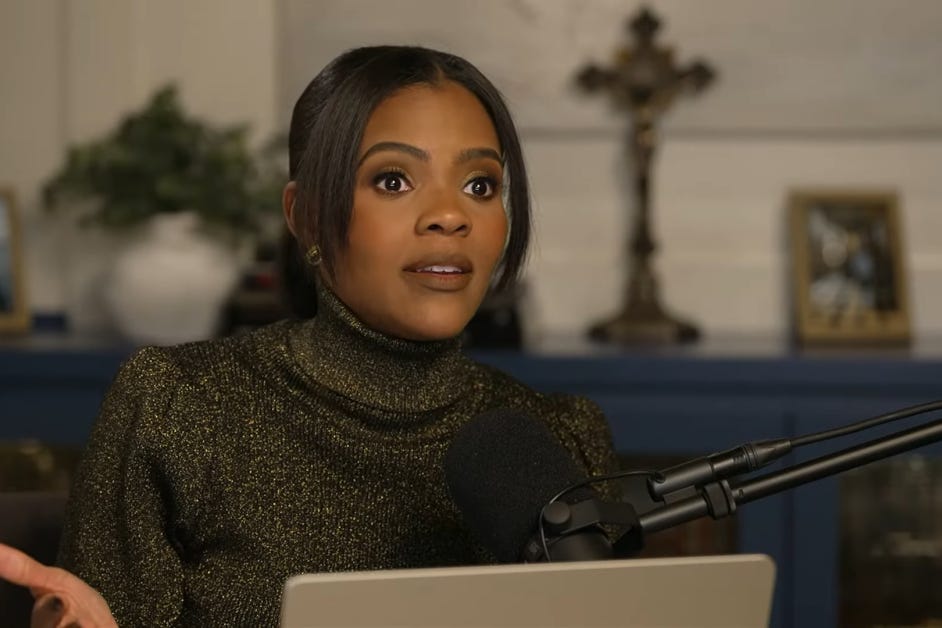
I am not a regular watcher of Candace Owens, as she really isn’t my bag. But I do pay attention to the content creation scene, and she is most certainly a major player. The Daily Wire scooped her up a few years back as part of a campaign to “diversify” their rotation. I imagine that the DW regrets that decision, as she famously turned on Ben Shapiro and Jeremy Boreing in the wake of the October 7th Hamas attacks on Israel. She was able to leverage her talents in a fantastic and ugly break up. She has a knack for turning drama into clicks, the true coin of the content-creator realm, and the few times I’ve watched her show cause me to shake my head. I do not get it. She is not terribly bright, but with her good looks and seemingly confident delivery, she can command attention.
These are two topics worthy of deeper consideration: confidence and attention. When she first started spouting off about Briggite Macron I was struck. I even said to myself something along the lines of: “wait, could this be true?” What allowed her passage through my bullsh*t detectors was the brazenness of her claims. I wasn’t ready for it as I do not care one iota about French politics. I mean, Macron is a strange character in a very strange and creepy story. And of course, she looks odd, too. And Candace looks to the camera and says “I will stake my entire fortune” on Brigitte being a man.
Well, that is not nothing I said to myself. Then she looks to the camera and boldly welcomed the process of legal discovery. Surely, I thought to myself, you wouldn’t say something like that without a mountain of real evidence to back up your claims. She would have so much to lose.
Oh, you sweet summer child, Kale.
It turns out that what I took to be confidence was really a Confidence Game (my go to source is Maria Konnikova’s The Confidence Game: Why We Fall For It Everytime). Candace did not, in fact, have the goods. She was riding the algorithm. She was playing a game. A game of confidence and a game of attention-jacking. Most of us do not have what it takes to play this one, where personal integrity and a personal code of ethics act as governors to what we say and write and publish. Given the “bullsh*tification” of everything in the digital age, most of us Olds are playing catch up. The very notion of the Confidence Game is that it traffics in faith: the sense that the person you are interacting with is Real. The con makes the mark believe.
The philosopher Henry Frankfurt delineates three types of speech in his book On Bullsh*t: honest speech, lying, and bullsh*t. Honest speech is straight forward, where the speaker is saying the truth (as they see it). Lying presupposes some grasp of the truth, but deliberately misleads other through speech. There is a knowing quality: the cat is *really* black, but I am saying it is orange. The speaker must know that it is true and are attempting to conceal it (for whatever reason). But bullsh*tting is a different thing all together. Their speech is characterized by an indifference. The speaker does not care whether what they are saying is true or not. Their goal is to create an impression, to persuade, impress or achieve some kind of effect on their audience. We are not immediately predisposed to the bullsh*tter and his game. The speech act itself is governed by a kind of pro-sociality. We learn the value of truth through consequence and correction. But for the fundamentally anti-social person, all such bets are off. Frankfurt notes:
When an honest man speaks, he says only what he believes to be true; and for the liar, it is correspondingly indispensable that he considers his statements to be false. For the bullshitter, however, all these bets are off: he is neither on the side of the true nor on the side of the false. His eye is not on the facts at all, as the eyes of the honest man and of the liar are, except insofar as they may be pertinent to his interest in getting away with what he says. He does not care whether the things he says describe reality correctly. He just picks them out, or makes them up, to suit his purpose.
There is a fundamental phoniness to the bullsh*tter, but it is a phoniness that can be weaponized upon the unsuspecting mark.
What happens when someone like Candace turns her audience into the mark? In confidence-games, all of which work in a pattern that exploits human sense-making: greed, fear, vanity, empathy, or the desire to appear smart or helpful. The confidence man or “con-man” works assiduously to groom the mark by establishing some kind of “relatable” relationship. In the past this required a different type of skill. Looking and sounding the part. The literature of the mid 19th century is filled with such flim-flam artists. Melville wrote a whole novel in 1857 called The Confidence- Game: His Masquerade attempting to get at the heart of this phenomenon. Published on April Fool’s Day, it was a commercial flop, but perhaps that is poetically apt. Pulling back the curtain is a dangerous business. People often prefer to be fooled.
In a typical con, the artist finds his mark, develops a rapport, moves on to the crucial step of building trust through small “proofs” that create the feeling of legitimacy, then they present some kind of opportunity (high return, low risk) to the mark, before making the play for an urgent opportunity. “Trust me, bro.”
The digital arena has opened up new avenues, and there is no “two-factor authentication” for the kind of games Candace (and others) are playing. The pay-off is being in the know, and the pay-off for the audience is to be part of those in the know. The allure of knowing what is up is too juicy to pass up. Typical governors do not apply to the con-artist.
Her felicity with obvious bullsh*t has reached its apotheosis with her frenetic activity around the Charlie Kirk assassination. Otherwise politically uninterested people have been taken in by her spellcasting. She has almost single-handedly turned folks against his widow Erika. She has figured out how to exploit certain oddities into a barn-burning conspiracy implicating (of course) the Joos, Turning Point USA, Mossad, mainstream media, and everyone who refuses to go along with her narrative. I’m not sure we have seen anything quite as brazen break containment like her red-yarning of this story. The incentives are pretty clear. She has made a lot of money off this bit. Her blatant disregard for the truth has exposed the ultimate con. Lies, damned lies works as a strategy. But for how long?
What is Candace Owens?
In Hans Georg Moeller and Paul D’Ambrosio’s book Your Profile and You: Identity After Authenticity the lays out the idea that our identities are shaped by evolving “identity technologies” that are systems constructing and validating who we are. They map out three phases or stages, including The Age of Sincerity (pre-modern and traditional), The Age of Authenticity (modern and romantic), and The Age of Profilicity (post-authentic/digital and contemporary). One can argue over the details and the timelines, but something curious happened when we fused identity with the digital domain. We have become our profiles which we curate to be viewed by others. Through what they call “second order processing” we watch others watch us, through posting for the likes, retweets, and comments. Perhaps this has forever changed the way most of us perform our being in the world. Profilicity builds and exploits the Sincere and the Authentic. The best con is the one that looks and feels the most real.
My claim is that Candace has mastered the dark arts of Profilic manipulation. I do not know how conscious she is of this dynamic, though I’m guessing she is as swept up in her own phantasmagoria as her audience. Those who have spent time around her say she is a cynical opportunist. What if both can be true?
In the Age of Profilicity, we treat the self as the mechanism through which we perform and commoditize the self. The dynamic of Profilicity can often lead to burnout and a deep warping of the self. Freya India does a fantastic job of laying out many of the dark sides of this commodification in her recent, excellent book Girls: Generation Z and the Commodification of Everything. We are doing this to ourselves. The entire digital economy is fueled by the ability to appear “real” online. But nothing is more fake. Candace has developed a special relationship with her audience, and one might even call it devotional. There’s a certain participatory liturgy involved in a live-stream, and her face is perfect. She is pretty and her big eyes are hypnotic. All the tricks are employed, so that her audience can drop questions in the chat, pay for a superchat question, get a shout out, feel like you are part of the team, purchase merch.
In other words, it is RELIGIOUS. Candace is a high-priestess, trafficking in gnostic fantasies which she metes out with absolute confidence. In Candace World it is perpetually today. The past is not prologue. Anything she claimed yesterday has no bearing on what she is claiming today. It is actually quite stunning.
Regular rank-and-file pundits do not know what to do with her, and any kind of engagement invites the wrath of her minions, and if you yourself are high profile enough, her wicked attention. I do not know why seemingly influential and powerful pundits are scared of her. Even my own tepid forays on X mentioning her absurdities have invited strange clap backs, especially amongst the Traditional Catholic crowd who believe that her attendance at the TLM gives her behavior the stamp of unquestionable legitimacy. No doubt this post will forever mark me as a “not getting it” and being a “boomer” and an “Israel apologist” and “in league with world jewry.” It is tiresome.

Which leads me to my last point: Candace is a Mean Girl. In Roselind Wiseman’s Queen Bees and Wannabes, a book that inspired the film Mean Girls, we see a basic taxonomy of the clique. She is talking about “meatspace” reality, but something fascinating happens when this gets projected and amplified on social media. There is the Queen Bee herself, the charismatic and socially powerful leader. She uses manipulation, exclusion, or rumors to dominate her space. She is the most influential. There is typically a Sidekick, the closest ally and clique enforcer. Her status is cemented by her close association. These two leaders employ Bankers, those who collect gossip and intel, as well as spreads it amongst the general masses. Her relevance is cemented by her ability to aggregate actionable intelligence. There are Floaters and even Torn Bystanders that make up part of this dynamic. And lastly, the Target, the one excluded, bullied, or gossiped about. She threatens the hierarchy. Candace is the ultimate social media Mean Girl. (You can plug in your favorite content creators in the above taxonomy, but I think you get my point.)
It all sounds rather hellish, and as someone who lives and works at a high school, I’ve seen it up close. But what if it jumps the containment of a campus and is amplified digitally? This is where Candace’s particular form of con-artistry achieves maximal force. In the attention economy, he (or she) who can command the attention, no matter if it is positive or negative, wins. Clicks are fueled by controversy, and as long as you are not the object of scrutiny, it can be delicious. She is confident and through that confidence gains attention. The truth is truly neither here nor there. The truth does not matter. But the trick is to make it appear as if you are maximally oriented towards truth and seek nothing but the truth. In Candace World, it is dark and evil kayfabe.
So why do I care about this stuff? My podcasting partner Steve Skojec asked me this question. I told him that I see in Candace something unique: she appears to actually believe what she is saying. What if the greatest Con Artistry is the the one in which the Con-artist comes to believe her own bullsh*t? That is terrifying, and perhaps provides some kind of warning to us all who spend time in the virtual sandbox, or better yet, the virtual high school.
We need someone in our lives who will keep us grounded. We need a friend. My sense is that the great fear of the Queen Bee is that she has no real friends. Only pawns in a sick game of make-believe.
Great article, of course I am biased, but have been appalled at what Candace was doing to Erica. Even if something is true, this is not the way a Christian operates, and I am convinced that this is not true. The devil loves to take a small grain of truth, surround it with lies, and pulverizes the innocent with it.
This is an excellent essay. I think you're absolutely correct.